Slow Your Roll: The Cult of Deliberate Dial-Up and the Millennials Who Worship at the Altar of Bad Connection
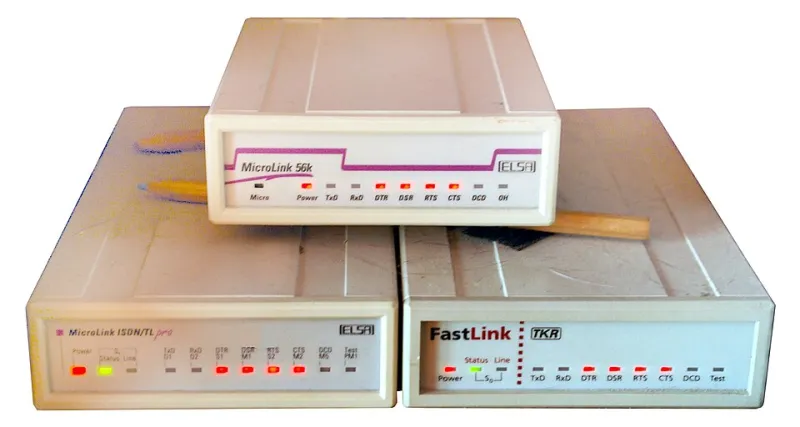
Photo: File:Elsa Modems IMGP0424.JPG: Johann H. Addicks - [email protected] derivative work: Pittigrilli, GFDL 1.2, via Wikimedia Commons
There is a man in Montpelier, Vermont, named Derek, and Derek is very, very calm. He is calm because his internet connection runs at approximately 0.4 megabits per second — a speed that would send most Americans into a full psychological spiral — and he has chosen this. Deliberately. With his whole chest. Derek pays a monthly fee to a service called Throttle & Chill (yes, real, no, we're not linking to it because it would take you forty minutes to load anyway) that artificially caps his bandwidth to simulate the approximate digital experience of the year 2001.
"People think I'm broken," Derek told us over a phone call, because video chat was, obviously, not an option. "I think they're the broken ones."
Welcome to the Bandwidth Ascetics. Pull up a chair. It's going to take a while to load.
What Is a Bandwidth Ascetic, Exactly, and Why Do They Look So Rested?
The term — which the community itself coined on a forum that takes roughly four seconds to render even on a normal connection, because irony is their love language — refers to people who have voluntarily downgraded their internet speeds as a form of what they call digital minimalism with teeth. Unlike the softer, more photogenic minimalism of decluttered linen closets and capsule wardrobes, Bandwidth Asceticism is about friction. It is about forcing yourself to wait.
The movement, if you can call it that, appears to have coalesced sometime around 2022, when a Reddit post titled "I throttled my connection to 1Mbps for a month and I feel like I can see God" accumulated enough upvotes to suggest this was not just one man's breakdown but a genuine cultural tremor. The post described an almost meditative transformation: the poster, a software engineer from Austin, Texas, reported that the enforced waiting periods between page loads had compelled him to, in his words, "actually think thoughts again."
The post now has over 47,000 upvotes. Make of that what you will.
The Theology of the Buffering Wheel
If you spend enough time in Bandwidth Ascetic spaces — and we did, which was a professionally humbling experience — you start to notice a spiritual vocabulary developing around what is, technically, just a bad router setting.
High-speed internet, in this worldview, is described as "frictionless to the point of dissolution." Gigabit fiber is spoken of the way a Victorian physician might have spoken of laudanum: pleasurable, ubiquitous, and quietly destroying everything it touches. The argument goes something like this: when content arrives instantly, you never have to want it. You never have to sit with desire. You never have to decide if a thing is worth the wait. You just consume, reflexively, the way a sea anemone consumes whatever the current delivers.
Throttling your connection, the logic continues, reintroduces intentionality. If a webpage takes ninety seconds to load, you will only visit webpages you actually care about. You will not, for example, spend forty-five minutes scrolling through the Instagram accounts of people you vaguely disliked in high school. You simply will not have the bandwidth — literally — for that kind of spiritual damage.
"The buffering wheel is a mandala," explained one community member who goes by the handle @33.6kbps_and_thriving on a platform that shall remain nameless. "You sit with it. You breathe. You remember that you are a person, not a content ingestion unit."
We did not push back on this. We were charmed. We are also slightly worried about ourselves.
The Apps, the Gadgets, and the Deeply Committed Freaks Building Them
For urban dwellers who cannot simply relocate to a Vermont farmhouse with spotty DSL, a small but enthusiastic cottage industry has emerged to bring the Bandwidth Ascetic lifestyle to you.
LagLife, an app available on both major platforms, allows users to set artificial speed caps on their devices, simulate packet loss (the technical term for when your internet just kind of gives up mid-sentence), and even reproduce the iconic screech of a dial-up modem connecting — not as a ringtone, but as a daily alarm, because these people are committed in ways that border on clinical.
SlowLoad, a browser extension, introduces randomized delays between clicks and page renders. It also occasionally displays a fake "Your connection is unstable" warning just to keep you honest. Reviews describe it as "deeply annoying" and "the best thing I've ever installed." The developer, a former Google engineer who left the company to, quote, "stop making the machine faster," describes it as "a patience prosthetic for the chronically overstimulated."
There are also hardware solutions. Certain communities have begun purchasing vintage networking equipment — routers from the mid-2000s, actual PCMCIA wireless cards — specifically because they are incapable of delivering modern speeds. This is, to be clear, the digital equivalent of choosing to travel by horse because cars are "too efficient."
The Rural Relocation Pipeline
For the truly devout, no app will suffice. The only authentic Bandwidth Asceticism is the kind enforced by geography.
A notable subset of the community has deliberately relocated to rural areas with poor or nonexistent broadband infrastructure — parts of Appalachia, the rural Midwest, certain stretches of the Mountain West where fiber is a rumor and 4G is optimistic. Real estate agents in some of these areas have begun, with barely concealed bewilderment, marketing properties by their lack of connectivity. "No cable, no fiber, DSL only" has reportedly appeared in at least a handful of listings as a selling point.
The irony that many of these individuals can afford to make this choice because of careers built on fast internet — tech workers, remote designers, developers — is not lost on the community. They discuss it openly and with a certain rueful self-awareness. "We built the cage," one member wrote in a post that took us a genuinely uncomfortable amount of time to read, "and now we're paying to leave it."
Is This Wellness, Rebellion, or Just Expensive Inconvenience?
StaticNoise is, institutionally, a website that exists at a domain so obscure it may or may not be a server glitch given human form. We have a natural sympathy for the signal-impaired. But we also feel obligated to ask: is any of this actually working?
The honest answer appears to be: sometimes, for some people, in ways that are genuinely difficult to measure. Several Bandwidth Ascetics report meaningful reductions in screen time, improved attention spans, and a renewed capacity to read books — actual books, with pages, that do not buffer. Others report that the whole thing lasted about three weeks before they caved and upgraded their plan during a particularly painful video call with their mother.
What the movement captures, even in its more eccentric expressions, is something real: the growing suspicion that speed, frictionlessness, and infinite availability might be selling us something we didn't agree to buy. That somewhere between 56k and 10 gigabits, we traded patience for compulsion and called it progress.
Derek, back in Vermont, seems unbothered by these philosophical complexities. When we asked how he was feeling about his connection speed after two years of intentional throttling, there was a long pause.
"Good," he said finally. "Really good. Also, my email just loaded. It was from my dentist. But I was present for it."
We're not saying he's right. We're not saying he's wrong. We're saying the buffering wheel is spinning, and maybe, just maybe, that's the point.