Tuning Into Emptiness: The Cult of Digital Static That's Replacing Your Meditation App
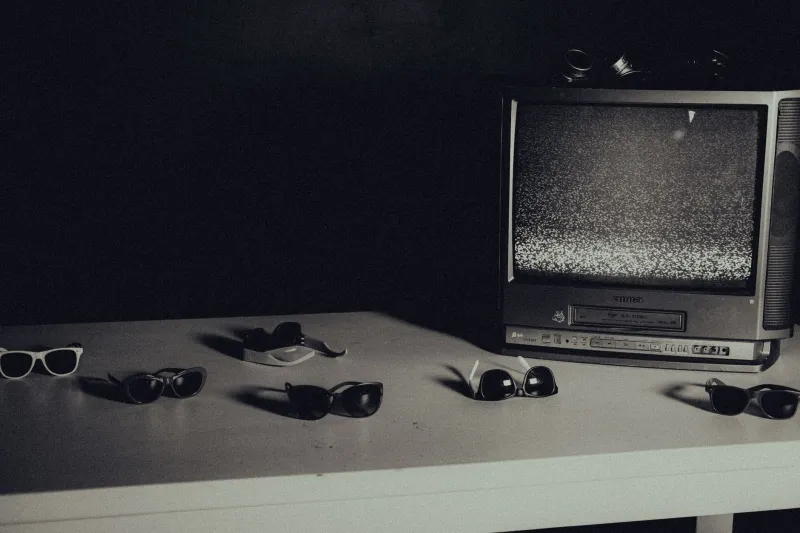
Somewhere between a broken television signal and a rainstorm that never quite arrives, there exists a frequency that a surprising number of people are calling peace. Not the guided, monetized, celebrity-endorsed kind of peace that arrives via a $12.99-per-month subscription. The other kind. The kind that sounds like a VHS tape left running after the movie ends, or a radio station that forgot to exist.
Welcome to the static wellness movement — and yes, it is absolutely a thing.
The Algorithm Is Loud. Static Is Not.
Here's the problem with modern digital wellness: it's still digital. Your meditation app knows your name, your streak count, and almost certainly your zip code. Your lo-fi hip-hop playlist was curated by a recommendation engine that also knows you bought compression socks at 2 a.m. last Tuesday. Even the most well-intentioned calming content arrives pre-packaged with metadata, engagement hooks, and the faint psychological residue of being watched.
Contrast that with static. True static — the white noise of a detuned AM radio, the low hiss of an analog tape, the ambient drone of a server room humming in a building nobody visits — contains no message. No intent. No algorithm. It is, in the most literal sense, signal without content. And for a population drowning in content, that distinction has become almost unbearably appealing.
"People are exhausted by meaning," says Marcus Trell, an independent sound designer based in Portland who has spent the last three years building what he calls "intentional noise environments" for corporate wellness retreats and private clients. "Every sound they encounter online is trying to do something to them. Static just... exists. It doesn't want anything from you."
Trell's client list, he says, has tripled since 2022. He charges between $400 and $2,000 for custom ambient static compositions — recordings that often contain nothing more dramatic than layered electromagnetic interference, the low-frequency hum of fluorescent lighting, and what he describes as "digital breath." His waiting list is currently six weeks long.
Your Brain on Nothing
The neuroscience here is, appropriately, a little fuzzy around the edges — which somehow makes it more believable.
Dr. Yolanda Fitch, a cognitive neuroscientist at the University of Washington who studies auditory processing and attention, explains that the appeal of ambient static likely has roots in something called stochastic resonance — a phenomenon where a certain level of background noise actually improves the brain's ability to detect and process weak signals. In plain English: a little bit of noise can make your brain sharper, calmer, and more focused than complete silence.
"Silence, for most people, isn't actually restful," Dr. Fitch notes. "In the absence of external sound, the brain tends to generate its own — intrusive thoughts, anxious loops, that thing you said at a party in 2014. White noise and ambient static give the auditory cortex just enough to chew on so it stops cannibalizing itself."
She's careful to distinguish between the therapeutic and the trendy, pointing out that white noise machines have been used in clinical settings for decades. What's new, she says, is the cultural reframing — the elevation of static from a technical nuisance to an aesthetic choice, even a philosophical statement.
The Aesthetics of Emptiness
It would be dishonest to pretend there isn't something deeply ironic about the monetization of nothing. And yet, here we are.
On platforms like YouTube and Bandcamp, creators with names like VoidFrequency, NoSignalAudio, and — our personal favorite — btrhbfeojofxcpxuwnsp5h7h22htohw4btqegnxatocbkgdlfiawhyid (we're not making that up; the internet is vast and strange) are racking up millions of combined streams with content that is, by design, devoid of content. Ten-hour uploads of analog television static. Eight-hour recordings of a humming hard drive. Twelve-hour compositions described only as "the sound of a domain nobody registered."
Creator Janelle Okafor, who runs the YouTube channel EmptyCarrier out of Austin, Texas, started uploading ambient static videos in 2021 as what she describes as "a joke that my insomnia took too seriously." Her channel now has 340,000 subscribers and generates enough ad revenue — the irony of which she fully acknowledges — to cover her rent.
"The first comment I ever got that wasn't sarcastic said, 'This is the first time in two years I've fallen asleep without medication,'" Okafor recalls. "After that, I couldn't really treat it like a joke anymore."
Her most popular upload, a 10-hour recording of electromagnetic interference from an unmaintained radio tower in rural Nevada, has 4.2 million views. The comments section reads like a support group for people who are tired of being perceived.
Disconnecting from the Signal
There's a broader cultural anxiety lurking underneath all of this, and it's not particularly subtle. We live in what media theorists have started calling a hypersignal environment — a world so saturated with targeted information, personalized content, and optimized engagement that the mere concept of unoptimized sound feels radical.
Static, in this context, isn't just relaxing. It's resistant. It's the audio equivalent of a website with no tracking cookies, no pop-up newsletter subscription, no "we value your privacy" banner that means the opposite of what it says. It is, in the most chaotic and accidental way possible, a form of digital minimalism.
"People aren't just looking for quiet," says Trell, the sound designer. "They're looking for unintentional sound. Something that wasn't made to manipulate their nervous system. Static is honest in a way that most audio content isn't."
Dr. Fitch agrees that the trend reflects something real about where we are culturally. "When the most soothing thing you can imagine is the sound of a broken signal," she says, "that tells you something about how people feel about the signals they're currently receiving."
Nothing Is the New Something
So where does this leave us? Probably exactly where you'd expect a website called StaticNoise to leave you: somewhere in the middle of the frequency dial, between a station that's trying too hard and the comfortable hiss of empty bandwidth.
The static wellness movement may be monetized, may be ironic, and may be at least partially a collective anxiety response dressed up in ambient aesthetics. But the underlying impulse — to find rest in the unstructured, to seek comfort in the uncurated, to let a sound exist without asking it to mean something — feels genuine in a way that a lot of wellness content doesn't.
Or maybe we've just been staring at our own domain name too long.
Either way: turn on some static. Close your eyes. Let the signal go unclear.
You were never really supposed to receive it anyway.