White Noise Nation: Inside the Quiet Revolution of Americans Sleeping to Static
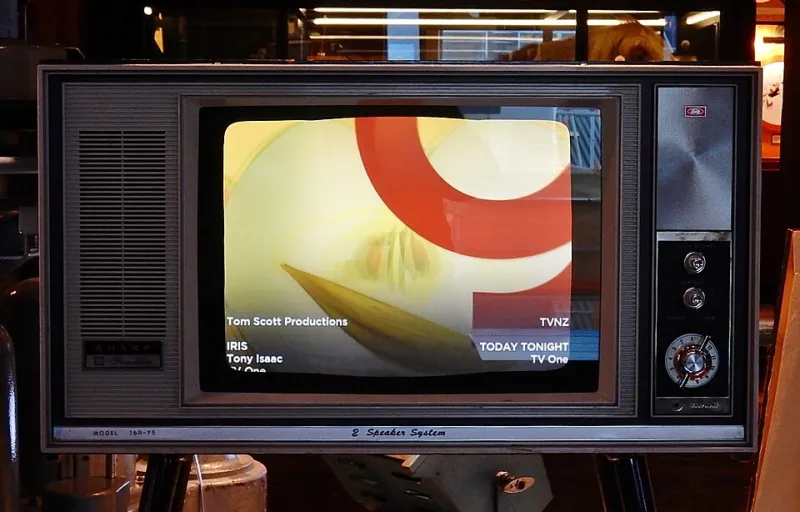
Photo: Michael Coghlan from Adelaide, Australia, CC BY-SA 2.0, via Wikimedia Commons
It's 11:47 p.m. in a suburb outside Columbus, Ohio, and Denise Kowalczyk is winding down the way she has every night for six years. She turns off the overhead light, plugs in her headphones, and presses play on a ten-hour video of a television channel that stopped existing sometime around 1993.
"People think I'm insane," she tells me over email, which, fair. "But I cannot fall asleep to a podcast. Someone's talking in there. The static doesn't want anything from me."
Denise is one of an estimated tens of millions of Americans who use some form of random noise — analog TV static, untuned FM radio hiss, fan recordings, brown noise loops — as a sleep aid. The sleep sound economy is huge and getting bigger. But a specific strain of it has curdled into something more interesting than wellness: a genuine subculture with opinions. Strong opinions. About the texture of nothing.
The Sommeliers of Hiss
"There's a difference between white noise and static, and if you don't know that, I can't help you," says a man who goes by the handle StaticDad online and maintains what he describes as a "curated library" of analog television static recordings, captured from actual cathode-ray tube sets he rescues from thrift stores and curbsides across the Midwest.
StaticDad — real name withheld, because he has a day job — speaks about his recordings the way a sommelier speaks about soil. "Digital white noise is mathematically random and it's fine," he says. "But analog static has history in it. There's the hum of the set, the occasional pop, the way the signal wavers because somebody's garage transmitter three counties over is bleeding in. It's not empty. It's abandoned."
He is not alone. Reddit communities devoted to noise recordings have swelled in recent years, with users trading notes on the best frequencies for anxiety, the ideal hiss-to-hum ratio, and whether a particular recording of a dead UHF channel "has a good mouthfeel." Yes, someone said that. About static.
Why Nothing Works
Here's the part that surprises people: the science roughly backs this up.
"The brain is a prediction machine," explains Dr. Alicia Ferreira, a sleep researcher who studies auditory environments at a university sleep lab in the Northeast. "In a silent room, your auditory system doesn't shut off — it turns the gain up. Every creak, every pipe, every car door becomes an event. Random, broadband noise masks those events and gives your brain something that doesn't require parsing. There's no narrative to follow, no words to process, no signal to decode. It's the absence of demand."
Ferreira notes that consistent broadband noise can also condition sleep onset — a kind of auditory security blanket. "The static becomes a cue. It says: nothing important is happening now. You're allowed to go."
There's also a generational wrinkle. A cohort of Americans who grew up in the CRT era — the '70s through the '90s, when stations actually signed off and screens actually went to snow — formed their earliest associations with sleep and television around exactly this sound. For them, static isn't random noise. It's a lullaby with a nostalgia subsidy attached.
"My dad used to fall asleep in the recliner with the TV on a dead channel," StaticDad says. "I'm not doing anything new. I'm doing what the recliner dads did. I've just industrialized it."
The Anxiety Angle
The sleep use case is only half the story. A parallel community uses static for anxiety — not to drown out the world, they insist, but to occupy the part of the brain that would otherwise be spiraling.
"My therapist actually suggested it," says Marcus, a 34-year-old in Portland who listens to recorded radio static during work calls. "She said some people need their attention held by something neutral. Static is neutral. It's the Swiss neutrality of sound."
Clinicians are cautiously on board. "It's low-risk," Ferreira says with a shrug you can hear over the phone. "If the alternative is doom-scrolling until 2 a.m., I'll take the snow."
The Sound of the Void, Sold Back to You
Of course, capitalism noticed. There are now premium static apps, subscription noise libraries, and — inevitably — a $349 speaker shaped like a mid-century television that does nothing but emit convincing analog static. Reviews are glowing. The comments section contains the sentence "it changed my marriage," which is either wonderful or the most StaticNoise sentence ever written.
Purists like StaticDad are unimpressed. "You can't subscription-model a dead channel," he says. "Static is the one thing left that isn't trying to sell you anything. That's the whole point. That's the entire point."
Then, after a pause: "Although I do sell my recordings. On Bandcamp. But it's pay-what-you-want."
The void, it turns out, has a suggested donation.